

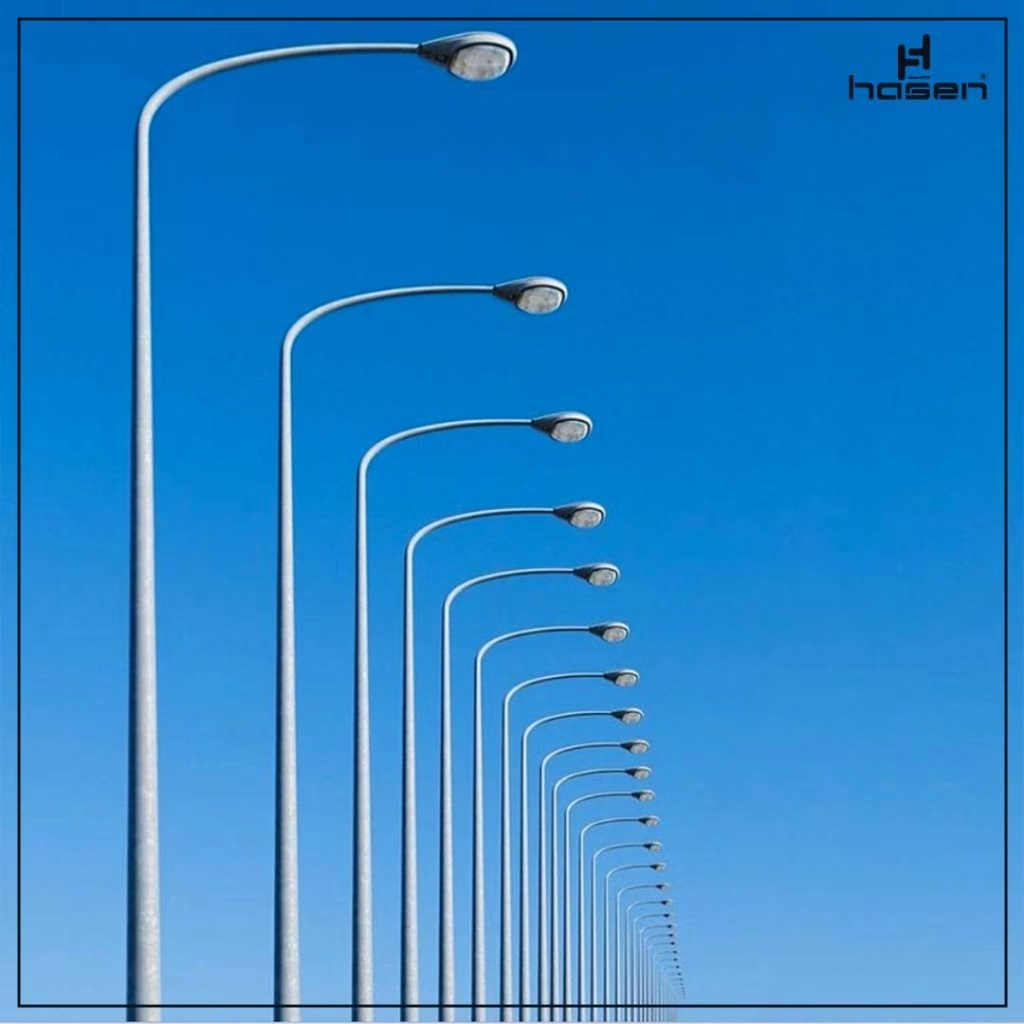
Road Lighting Poles: Critical Infrastructure Solutions for Urban Safety and Aesthetics
Cities are dynamic environments that continue to live, work, and move even after sunset. For this reason, they need to remain as safe, comfortable, and aesthetically appealing at night as they are during the day. One of the most important infrastructure elements ensuring the continuity of urban life is undoubtedly road lighting poles.
Road lighting poles that are correctly positioned and manufactured in accordance with technical requirements do much more than illuminate roads. They can also contribute directly to reducing accidents, improving public safety, enhancing urban aesthetics, and increasing energy efficiency.
Today, municipalities, organized industrial zones, residential developments, airports, ports, and highway operators are increasingly turning to long-lasting infrastructure solutions with low maintenance requirements. As a result, road lighting poles are no longer considered simply metal structures; they are regarded as products that combine engineering, design, and technology.
With decades of industry experience, advanced manufacturing technologies, and a quality-focused approach, Hasen Flagpoles is an experienced manufacturer of lighting pole systems in Türkiye. Hasen Flagpoles also adds value to the nighttime appearance of cities through project-specific dimensions, durable materials, and aesthetically focused designs. For projects requiring customized dimensions and engineering solutions, custom-manufactured pole systems can provide greater flexibility.
Lighting poles perform several critical functions in modern urban environments. In a city without an effective lighting system, drivers may experience reduced visibility, pedestrians may feel less secure, and public spaces can lose much of their functionality after dark.
A carefully planned road lighting pole infrastructure, on the other hand, can improve both individual safety and the overall quality of urban life. For this reason, lighting systems are no longer merely a basic necessity; they have become an important component of sustainable urban planning.
Road Lighting Pole Models and Design Features for Different Project Requirements
Not every road or city has the same requirements. Road width, traffic density, environmental conditions, aesthetic expectations, and project budget can all directly affect the type of road lighting poles required.
Instead of relying on a single standard design, different pole models are therefore manufactured with various technical and aesthetic characteristics.
Single-Arm Road Lighting Poles
Single-arm models are commonly preferred for urban streets and local roads. These road lighting poles are generally positioned on one side of the road and provide illumination in a single direction.
Their ability to provide effective light distribution while offering an economical solution makes them one of the frequently preferred options for municipal lighting projects.
Double-Arm Road Lighting Poles
Designed for wide and bidirectional roads, double-arm road lighting poles provide illumination in both directions and help create a more balanced lighting layout.
They are particularly suitable for divided roads, highways, wide avenues, and major intersections.
Decorative Road Lighting Poles
Decorative lighting poles are preferred in locations where visual design and architectural harmony are especially important.
They are frequently used along coastal roads, in parks, historical districts, public squares, and tourist destinations. These road lighting poles can be designed to complement the architectural identity and visual character of the surrounding area.
Smart City-Compatible Lighting Poles
Many municipalities are now adopting systems that support lower energy consumption and remote management.
Sensor-equipped, solar-powered, and LED-compatible road lighting poles have therefore become an important part of modern smart city projects.
These technologies can enable lighting levels and operating times to be managed more efficiently according to actual requirements.
Durability and Quality: The Importance of Galvanizing in Road Lighting Pole Manufacturing
Because road lighting poles are continuously exposed to outdoor environmental conditions, corrosion can become an important long-term concern.
For this reason, galvanized coating is one of the key factors affecting the durability and service life of steel lighting poles.
What Is Galvanized Coating?
Galvanizing is a process used to protect steel and iron-based metal surfaces against corrosion by coating them with zinc, commonly through immersion in a bath of molten zinc.
This method creates a uniform protective layer on both the internal and external surfaces of the metal, helping provide high resistance against environmental exposure.
Hot-dip galvanizing does more than create a physical barrier over the steel surface. Zinc also provides electrochemical protection to the underlying steel. This means that even if minor scratches or surface damage occur, the zinc coating can continue helping protect the base metal.
This characteristic makes galvanizing one of the widely used surface protection methods for outdoor metal structures.
For products such as road lighting poles, which remain exposed to outdoor conditions throughout their service life, galvanizing can reduce the risk of corrosion, extend service life, lower maintenance requirements, and help reduce long-term operating costs.
Material and surface protection choices should always be evaluated according to the environmental conditions of the project. You can also read Hasen Flagpoles’ guide on why stainless steel is preferred for outdoor poles for more information about material durability in outdoor applications.
- Long Service Life: Properly manufactured and protected road lighting poles can provide long-term resistance to outdoor conditions, helping reduce maintenance and replacement requirements.
- Suitable for Challenging Climate Conditions: Galvanized road lighting poles can provide increased corrosion protection in coastal environments, industrial areas, and locations with high humidity.
What Are the Height Standards for Road Lighting Poles on Highways and Urban Roads?
Selecting the appropriate height for road lighting poles is not simply an aesthetic decision. Pole height directly affects visibility, light distribution, driving safety, glare control, and energy efficiency.
An inappropriate mounting height may cause uneven light distribution across the road surface, excessive glare for drivers, or insufficiently illuminated areas.
For this reason, lighting pole height should be determined according to the road type, lighting requirements, environmental conditions, luminaire characteristics, and applicable project standards.
1. Height Guidelines for Urban Roads
For urban roads and streets, road lighting poles are commonly selected in the range of approximately 6 to 9 metres, depending on factors such as road width, traffic volume, surrounding building heights, and pedestrian activity.
For narrow streets with lower speed limits, poles measuring approximately 6–7 metres may be suitable.
On main urban arteries, public transport routes, and roads with heavier traffic, poles in the range of approximately 8–9 metres may be preferred.
Appropriate mounting heights help distribute light more evenly across the road surface, reduce dark areas, and control glare for drivers. They can also improve pedestrian visibility while contributing to a lighting infrastructure that complements the overall urban environment.
2. Height Guidelines for Highways and Intercity Roads
Road lighting poles used on highways and intercity roads are generally taller than those used on local urban streets.
Depending on road geometry and project requirements, heights of approximately 10 to 14 metres are commonly considered.
Poles measuring around 10–12 metres may be used on divided roads and intercity connection routes, while heights of approximately 12–14 metres may be preferred for wider areas such as highways, major intersections, viaducts, and toll areas.
Greater mounting heights can help provide broader light distribution and improve forward visibility for vehicles travelling at higher speeds.
For highways, large intersections, toll areas, airports, ports, and other locations requiring high-output illumination, floodlight pole systems can also be evaluated according to the technical requirements of the project.
3. Relationship Between Pole Height and Pole Spacing
There is a direct relationship between the height of lighting poles and the distance between them.
The correct combination of height and spacing is essential for achieving uniform illumination, limiting dark areas, and creating a comfortable visual environment for both drivers and pedestrians.
Rather than determining spacing solely according to pole height, the final layout should also consider factors such as luminaire output, beam distribution, road width, mounting arrangement, and photometric calculations.
Typical Pole Height and Spacing Reference Table
| Pole Height | Typical Distance Between Poles | Example Application |
|---|---|---|
| 6–8 Metres | 25–35 Metres | Narrow streets and low-speed urban roads |
| 9–10 Metres | 35–45 Metres | Main arteries and busy urban roads |
| 12–14 Metres | 45–60 Metres | Highways, viaducts and wide intersections |