

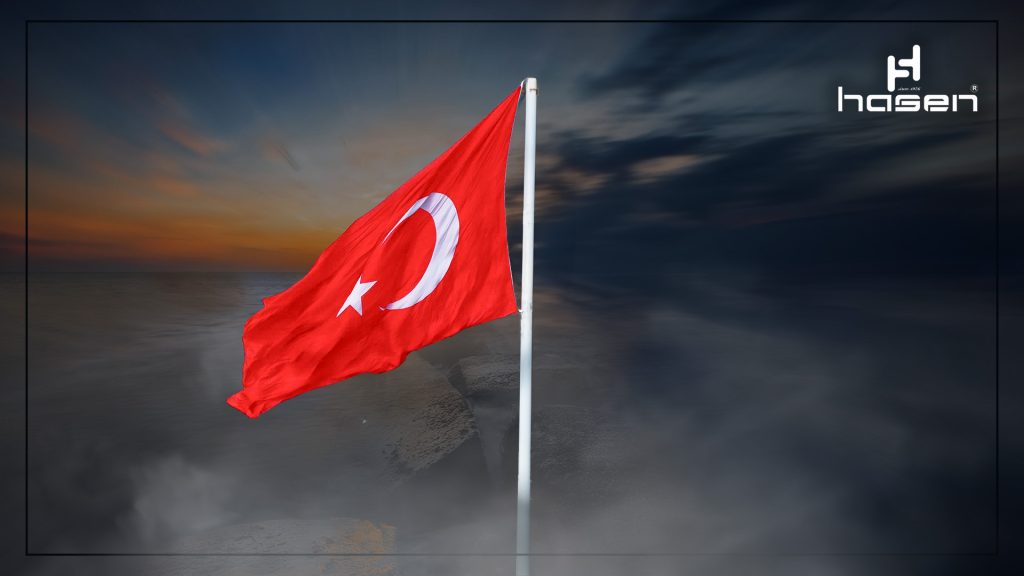
As the wind blows, we see our flag waving almost everywhere throughout the day. Perhaps we watch it proudly fluttering on a slender, upright pole reaching towards the sky. At that moment, it’s not just a piece of cloth; it’s the ascent of history, struggle, identity, and culture to the heavens.But often, the flagpole that raises our proud flag goes unnoticed. In fact, these durable and sturdy metal structures carry all the meaning our flag represents. Like silent but powerful protectors, they safeguard our flag and proudly display a nation’s freedom and independence, waving hope for all to see.Today, as a company with half a century of experience in flagpole manufacturing and installation, we wanted to share some aspects of flagpoles that you might be curious about. If you’re ready, here are some interesting facts about flagpoles.
As the Hasen Paslanmaz family, with 50 years of experience, we continue to lead the industry in the production, installation, and setup of stainless steel flagpoles. Our TSE-certified flagpoles not only offer aesthetics and durability, but also demonstrate quality and reliability through certified standards. Combining long-lasting performance, resistance to harsh weather conditions, and engineering precision, they add value to every project. With the expertise we’ve gained over the years, we provide durable and visually appealing flagpoles suitable for a wide range of settings from municipalities to airports, hospitals to universities, marinas to hotels, and embassies to public institutions. Hasen Paslanmaz flagpoles rise proudly not only across Turkey but also in many countries around the world.
A flagpole is not just a metal structure; as the support for the flag that waves atop it, it has become a symbol of national identity, independence, and social unity. Throughout history, flagpoles have provided a symbolic platform where societies proclaim their existence, commemorate victories, and honor moments of mourning. Since ancient times, flags raised on poles in battlefields have been used to demonstrate the authority of an army or a people.
Primitive and Symbolic Flagpole (Ancient Period)
The earliest examples of flagpoles discovered through archaeological excavations belong to the Ancient Egyptian and Persian civilizations. Around 2000 BCE, the Egyptians used symbols on sacred poles erected as offerings to their gods. The Persians, on the other hand, aimed to symbolize unity and power with standards mounted on tall poles. In China, imperial flags were displayed on high poles in ceremonial grounds to reinforce the authority of the ruling power.
In the Middle Ages, wars were mostly fought within the framework of chivalry and feudal structures. During this period, flagpoles were typically made of wood, designed to be easily portable, and used on battlefields or castle towers. Flags were adorned with coats of arms representing a commander’s, lord’s, or knight’s identity and allegiance, making it clear which side was which in battle. Knights would carry their own banners and emblems at the tips of their lances, providing recognition while representing their honor. Flagpoles served not only military purposes but also ceremonial functions. Especially during the Crusades, flags bearing religious symbols reinforced the sense of sacred duty. This era reflects an important historical period when the flag emerged as a symbol of both personal and collective belonging.
During the Renaissance and early modern period (1500–1800), flagpoles developed both technically and symbolically. With the rise of maritime activities, ship-mounted flagpoles gained greater importance, becoming longer and sturdier. In addition to wooden poles, this period marked the beginning of using more durable materials such as iron for flagpoles. Flags came to represent not only military units but also nations and commercial ships, and tall flagpoles began to be erected in ports, castles, and city squares. Pulley and rope systems were developed during this time, making it easier to raise and lower flags.”
During the Industrial Revolution and the following period (1800–1900), flagpoles underwent a significant structural and functional evolution. New materials and production techniques brought by industrialization greatly transformed flagpole design. Wooden poles were replaced by more durable and long-lasting materials, particularly cast iron and steel. Flagpoles became taller and sturdier, gaining greater visibility in city squares, public buildings, and war memorials. Pulley and rope systems were also developed, making it more practical to raise and lower flags. Flagpoles were no longer limited to battlefields; they began to serve as symbols of diplomatic representation and national pride. During this era, the design and construction of flagpoles became an important emblem reflecting nations’ displays of power and the technological advancements of industrialized societies.
In the modern era, where flagpoles have reached their most advanced form, they have taken on a whole new dimension, shaped by technological innovations. Since the beginning of the 20th century, flagpoles have been manufactured using durable materials such as aluminum, steel, and stainless steel, making them more striking in terms of both structural integrity and aesthetics. Thanks to electric and motorized mechanisms, flags can now be raised and lowered automatically, providing significant convenience to users. Furthermore, rotating finials (trucks) that adjust according to wind direction ensure that the flag waves smoothly under all conditions. With the construction of high-rise buildings and monuments, exceptionally tall flagpoles have begun to occupy prominent locations such as city squares, public spaces, and diplomatic missions. In the modern era, flagpoles have evolved into significant structures symbolizing national identity and international relations, just as they do today.
Hasen Paslanmaz offers a wide range of flagpoles to meet various needs:
Flagpoles are generally made of aluminum, galvanized steel, or stainless steel. Stainless steel and galvanized poles are more durable. These characteristics can cause variations in cost.
As flagpole height increases, the materials and labor required also increase. This is a determining factor in the total cost.
Flagpole and Its Design
Flagpoles with logos or custom designs may vary in price depending on the production process.
The installation and transportation costs of tall flagpoles can be significant, especially for longer poles. This is one of the factors that affects the overall cost.
Hasen Paslanmaz flagpoles are manufactured with high-quality materials and are long-lasting. They can be used even in harsh weather conditions. They require less maintenance over a long period, saving you money.
As Hasen Paslanmaz, our TSE-certified flagpoles do more than just offer aesthetics and durability; they provide documented proof of our quality and reliability standards. Long-lasting use and resistance to harsh weather conditions are combined with engineering precision to add value to every project. Merging stainless steel technology with an’unbounded vision of engineering, Hasen Paslanmaz develops projects in more than 100 countries, from Europe to Asia. Producing robust flagpoles resistant to every climate and geography, Hasen Paslanmaz never compromises on its goal of 100% customer satisfaction, both domestically and abroad. If you wish to fly your flag with pride, you can choose Hasen Paslanmaz’s wide product range and high-quality service approach.
For detailed information about flagpole prices, which vary based on factors such as material quality, pole height, installation method, and optional equipment, you can review our blog post titled How are Flagpole Prices Determined?