

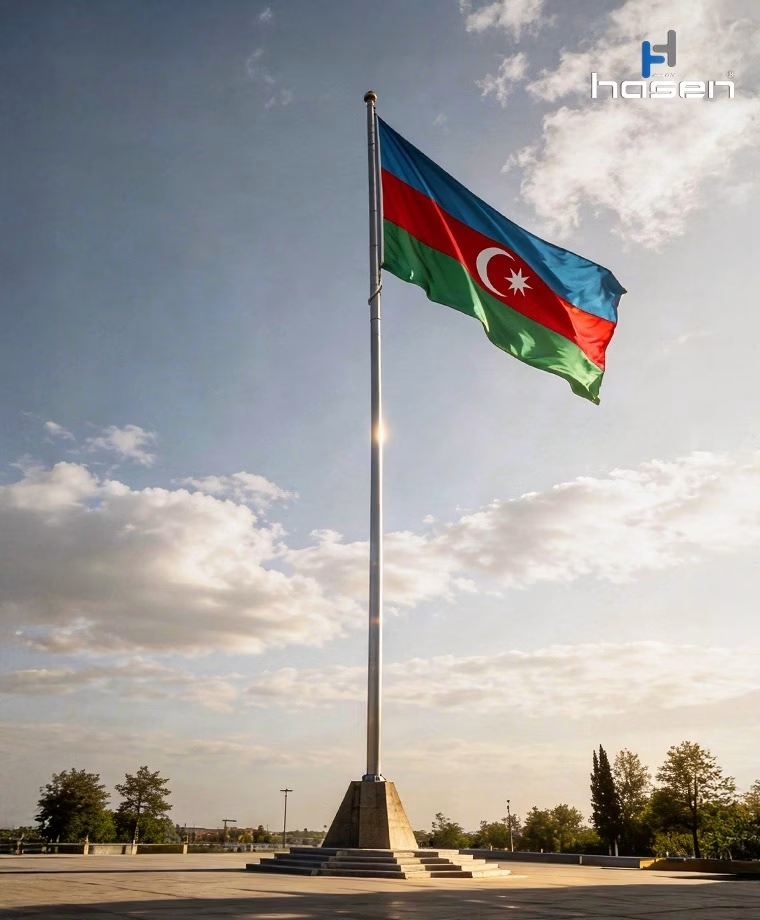
Flags displayed proudly in front of corporate buildings, companies, and public institutions are among the most visible symbols of institutional identity and prestige. Maintaining this appearance safely, aesthetically, and continuously depends largely on the engineering quality of the flagpole.
Flagpoles with a height of around 10 meters are more than simple visual elements. They are structural components that must be designed by considering wind loads, environmental conditions, material strength, foundation requirements, and other engineering factors.
For this reason, choosing the right product and material is essential for long-term durability and safe performance. So, what technical characteristics should a 10-meter flagpole have? Why is material selection important, and which factors influence 10 meter flagpole prices? Here are the key details.
What Is a 10 Meter Flagpole and Where Is It Commonly Used?
A 10 meter flagpole provides strong visibility while maintaining proportions suitable for many architectural and corporate projects.
Its height makes it a popular option for locations that require greater visibility without moving into the scale of monumental flagpoles.
Common application areas include:
- Corporate headquarters
- Government buildings
- School campuses
- Fuel stations
- Factory entrances
- Business plazas
- Military facilities
- Public institutions
- Commercial complexes
When selected according to the scale of the building and its surroundings, a 10-meter pole can integrate effectively with the architectural silhouette while providing strong visual representation.
For more information about determining appropriate pole heights, you can review the Flagpole Length Guide.
What Technical Features Should a 10 Meter Flagpole Have?
A 10-meter flagpole should be manufactured according to appropriate technical requirements so that it can withstand varying weather conditions and provide safe performance over many years.
At this scale, appearance alone is not sufficient. Engineering criteria such as structural strength, resistance to wind loads, material quality, pole geometry, wall thickness, foundation design, and connection details are equally important.
Why Are Wind Resistance, Structural Calculations, and Wall Thickness Important?
As the height of a flagpole increases, wind forces create greater bending forces on the structure.
For this reason, a 10-meter pole should be designed with an appropriate structural profile, generally using a wider diameter at the base and a narrower diameter toward the top.
Conical or stepped designs can help provide the structural characteristics required for taller flagpoles while also maintaining an elegant appearance.
The required wall thickness should not be selected according to height alone. Factors such as material type, pole diameter, wind conditions, flag dimensions, installation location, and structural calculations should all be evaluated together.
Hasen Flagpoles manufactures stainless steel flagpoles using AISI 304 stainless steel, with pipe wall thicknesses selected according to the technical requirements of the product.
How Do the Anchor System and 360-Degree Rotating Mechanism Work?
Anchor System:
The anchor system securely connects the flagpole to its concrete foundation. Steel anchor rods and the base flange transfer structural loads from the pole to the foundation.
Depending on the flagpole design, hinged flange systems can also make lowering and raising the pole easier during installation or maintenance.
360-Degree Rotating Mechanism:
The rotating mechanism positioned at the top of the flagpole allows the flag attachment system to rotate according to the direction of the wind.
This helps prevent the flag from wrapping around the pole and can reduce unnecessary stress on the flag fabric.
Internally roped systems also keep the rope or cable inside the pole, creating a cleaner appearance and protecting the mechanism from external exposure.
Hasen Flagpoles offers these components among its flagpole accessories, including rotating mechanisms, rope winding systems, anchor components, and decorative base elements.
How Does Material Quality Affect 10 Meter Flagpole Prices?
One of the main factors determining 10 meter flagpole prices is the type and quality of material used in production.
Environmental conditions, expected service life, maintenance requirements, structural strength, and appearance all influence material selection and therefore have a direct impact on cost.
For projects requiring long-term and reliable performance, the mechanical and corrosion-resistant properties of the selected material should be evaluated together with the initial investment cost.
What Are the Durability and Cost Differences Between Stainless Steel, Galvanized Steel, and Aluminum?
Galvanized Steel:
Galvanized steel is protected against corrosion through a zinc coating. It is commonly used in outdoor infrastructure projects and can offer a cost-effective solution when the coating system is properly selected and maintained.
Surface coatings and paint systems may also be applied depending on the aesthetic and environmental requirements of the project.
Aluminum:
Aluminum is lightweight and naturally resistant to corrosion. Its lower weight can provide advantages during transportation and installation.
However, for taller poles, structural dimensions and wall thicknesses must be engineered according to wind loads and project requirements.
Stainless Steel:
Stainless steel is widely preferred for premium flagpole applications because of its durability, corrosion resistance, and modern appearance.
It does not require conventional paint coatings to achieve an attractive finish and can be produced with polished or satin surfaces.
Although its initial investment cost may be higher than some alternatives, reduced maintenance requirements and long service life can provide significant long-term value.
For more information about the material’s outdoor performance, you can read Why Is Stainless Steel Preferred for Outdoor Poles?.
Why Is Stainless Steel Particularly Suitable for Outdoor Flagpoles?
Outdoor flagpoles are continuously exposed to rain, snow, solar radiation, humidity, temperature changes, pollution, and wind.
For this reason, the material used must maintain both its structural performance and its appearance under long-term outdoor exposure.
Stainless steel provides strong resistance to corrosion and can maintain an attractive surface without requiring conventional painted finishes.
AISI 304 stainless steel is widely used for general outdoor applications, while the exact material grade should always be selected according to environmental conditions and project requirements.
In coastal areas or more aggressive environments, material selection requires particularly careful evaluation because salt exposure can increase the risk of corrosion.
A well-designed stainless steel flagpole combines structural performance with a clean and professional appearance, making it particularly suitable for corporate headquarters, public buildings, plazas, factories, and prestigious architectural projects.
How Is a 10 Meter Flagpole Installed?
Installation begins with proper foundation planning.
The ground conditions and structural requirements of the project are evaluated, after which a reinforced concrete foundation is prepared according to the installation design. Anchor rods are positioned in the concrete to create the structural connection between the flagpole and the foundation.
After the concrete reaches sufficient strength, the pole is mounted to the anchor system through its base flange.
When the pole is in a horizontal or accessible position, components such as the internal rope mechanism, rotating head system, flag attachments, and other accessories can be installed.
The pole is then raised, aligned vertically, and secured through the appropriate fastening system.
Professional installation is particularly important for taller flagpoles because foundation design, wind loads, pole geometry, and anchoring must work together as a complete structural system.
What Factors Affect Current 10 Meter Flagpole Prices?
When comparing 10 meter flagpole prices, differences between products are generally caused by their technical specifications rather than height alone.
The main factors affecting price include:
- The main material used in production
- Stainless steel grade and material specifications
- Base and top diameters of the pole
- Pipe wall thickness
- Total amount of material used
- Pole manufacturing method
- Conical or stepped construction
- Internal rope or cable system
- 360-degree rotating mechanism
- Anchor and flange system
- Decorative base components
- Surface finish
- Flag dimensions
- Installation requirements
- Transportation requirements
- Custom engineering or project-specific production
- Changes in raw material prices
Hasen Flagpoles’ guide on how flagpole prices are determined also emphasizes that material quality, dimensions, additional design requirements, installation, environmental conditions, and wind loads should be considered together when evaluating cost.
Where Can You Buy a Reliable and Durable Stainless Steel Flagpole?
A flagpole should be treated as an engineered outdoor structure rather than a simple metal product.
Poorly designed poles or inadequate foundation systems can create safety risks under strong wind conditions. For this reason, the manufacturer should have experience in material selection, structural design, metal processing, accessories, and installation requirements.
When selecting a supplier, factors such as product specifications, engineering approach, material quality, manufacturing standards, installation support, and long-term durability should be evaluated together.
Why Choose Hasen Flagpoles for Your 10 Meter Flagpole Project?
Producing a safe, durable, and visually impressive 10 meter flagpole requires a combination of engineering, material expertise, and manufacturing quality.
Hasen Flagpoles has been manufacturing flagpoles since 1976 and develops solutions for corporate, public, commercial, and large-scale infrastructure projects.
Hasen stainless steel flagpoles are manufactured using AISI 304 stainless steel and can incorporate technical components such as hinged base flanges, internally roped systems, rope winding mechanisms, decorative base elements, and 360-degree rotating mechanisms.
These systems help combine durability, ease of use, and a clean architectural appearance.
For a 10-meter flagpole project, the most appropriate configuration should be determined according to installation location, wind conditions, flag dimensions, foundation requirements, material selection, and project-specific expectations.
With its long-standing manufacturing experience, Hasen Flagpoles provides engineering-focused flagpole solutions designed to combine safety, durability, functionality, and aesthetics.