

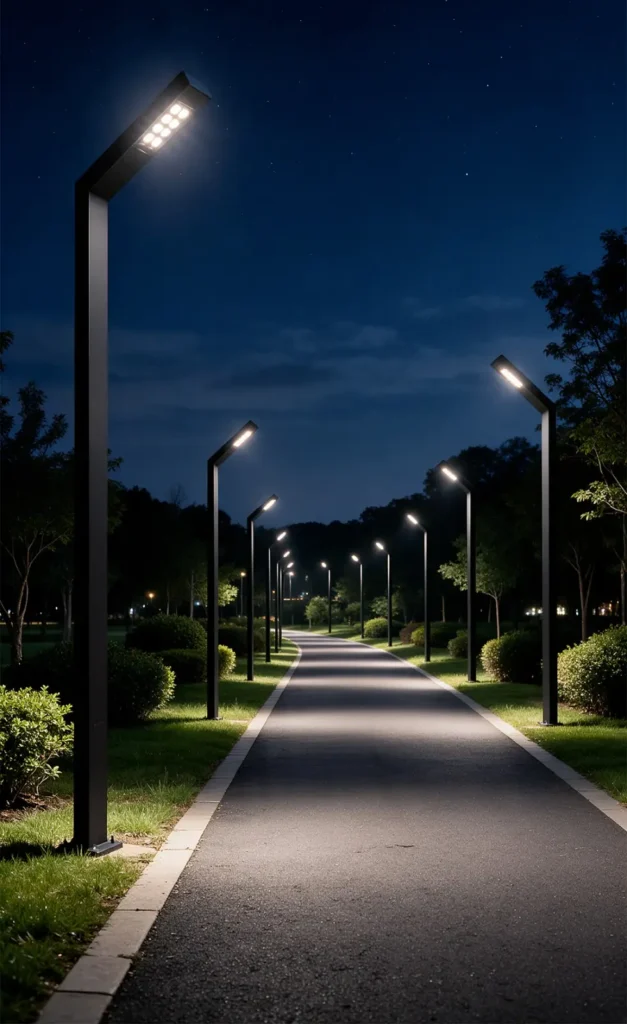
When the sun sets and evening falls, cities reveal a different side of themselves. Walkways that disappear during the day beneath the shade of trees and the rush of people are reshaped after dark by the gentle touch of light. Along a coastal path, lights reflecting on the sea accompany the rhythm of a walk, while tree-lined paths in parks stretch through the dimness like elegant lines. Sometimes, what becomes beautiful without us even noticing is not simply the light itself, but the way it is used in the right place.
Today, lighting systems play a role in urban aesthetics that goes far beyond simply eliminating darkness. Lighting poles positioned along both sides of a walkway define the boundaries of the route and make trees, landscaping, and architecture visible at night. On a promenade extending along the coast, the form of the pole and the distribution of light can directly influence the atmosphere of the scenery. For this reason, a well-designed walkway lighting system is one of those details that may go largely unnoticed during the day but can transform the character of a space at night. However, on a walkway, it is not enough for lighting poles merely to illuminate the path. To create an effective system, the position, height, and spacing of the poles, the light distribution of the luminaire, and the resistance of the selected material to outdoor conditions must all be considered together. Otherwise, some points may become excessively bright while dark areas appear only a few metres away. Therefore, before selecting the poles, the first step should be to assess the site. Especially for long routes, coastal paths, and landscaped areas, the following steps should be followed during the planning process:
- The characteristics of the walkway are identified:
The width, length, slope, bends, and level of use of the walkway are examined. Especially on heavily used main routes, the aim should be for the walkway lighting solution to provide balanced visibility along the entire path.
- The surrounding landscape and structures are examined:
Trees, shrubs, walls, buildings, and seating areas can directly affect how light is distributed. Therefore, when determining the position of lighting poles, both the current condition of nearby plants and the size they may reach in the future should be taken into account.
- The pole height and model are selected:
The appropriate pole height is determined according to the width of the path, its intended use, and the characteristics of the selected luminaire. Decorative or bollard-type solutions are often preferred in parks and gardens, while poles of different heights may be used along wider pedestrian routes.
- The luminaire’s light distribution is determined:
In a walkway lighting project, the wattage of the luminaire alone is not a sufficient selection criterion. The angle at which the light is distributed, how much of the path it covers, and how smoothly it transitions between poles should also be examined.
- The spacing between poles is calculated:
This step should be planned carefully to ensure uniform illumination of the area. Otherwise, sections that receive insufficient light may occur. For this reason, pole height, path width, and the photometric characteristics of the luminaire should be evaluated together to determine an appropriate layout.
- Materials are selected according to the area of use:
Humidity, rainfall, sunlight, salty air, and other environmental factors are decisive when selecting materials for walkway lighting poles. Particularly on coastal paths, materials with high corrosion resistance and suitable surface treatments should be assessed more carefully.
- The electrical and installation infrastructure is designed:
Cable routes, pole foundation points, anchor connections, and maintenance access should be planned before installation. In projects where solar lighting is preferred, the solar exposure conditions of the panel should also be examined separately.
- A photometric check is carried out:
Before the final positions of the poles are determined, the distribution of light on the ground should, where possible, be verified through photometric calculations. This makes it possible to evaluate not only the aesthetic appearance of the walkway lighting system, but also its actual lighting performance along the route.
Why Are Walkway Lighting Systems Important?
When evening falls, the character of parks, coastal paths, and landscaped areas changes. Routes that appear to be simple passageways during the day can, when properly illuminated, become spaces that reveal the surrounding trees, landscaping, and architectural texture. These systems have functions beyond simply producing light, which can be listed as follows:
Provides a safer walking environment:
On a sufficiently and evenly illuminated path, people can more easily notice changes in ground level, steps, kerbs, and potential obstacles.
Makes the direction and boundaries of the route visible:
Properly positioned lighting poles define the course of the path and provide visual guidance for users. Intersections, bends, and points where routes split are particularly important in this respect.
Transforms the nighttime appearance of parks and landscaped areas:
Lighting can make not only the ground but also surrounding trees, plants, seating areas, and architectural elements visible. Controlled use of light can create a more aesthetic nighttime atmosphere while preserving the natural character of the area.
Reduces harsh transitions between dark and overly bright areas:
If there is very intense light directly beneath the poles while clearly dark areas form between two poles, the result can be visually uncomfortable for users. For this reason, a good system focuses not only on high light levels but also on balanced light distribution.
Increases the usability of spaces during the evening:
Parks, coastal walkways, residential complex paths, hotel gardens, and campuses are not used only during daylight hours. A properly designed lighting system can make these areas more suitable for walking and outdoor activities.
How Should the Right Lighting Pole Be Selected for Walkways?
When selecting a lighting pole, aesthetic appearance is of course important. However, for this type of pole, factors such as cross-sectional design, material, surface treatment, and installation details should be considered just as carefully as appearance. In particular, the following criteria should be taken into account:
- Material: The choice between stainless steel, galvanised steel, or other metal solutions should be made according to the project environment and its exposure to humidity, rainfall, salt, and chemical effects.
- Cross-section and wall thickness: Looking only at the pole’s outer diameter is not sufficient. The mechanical properties of the material, wall thickness, and total pole height should be evaluated together.
- Installation method: A flanged base plate, anchor connection, or other project-specific installation solutions may be used. The concrete base and anchoring system must be compatible with the pole.
- Luminaire connection: The connection detail at the top of the pole should be compatible with the weight and mounting method of the luminaire to be used.
- Maintenance access: Easy access to electrical connection points and required service areas provides an important advantage for the long-term use of the system.
What Are the Advantages of LED Walkway Lighting?
Due to their low energy consumption and long service life, LED luminaires are frequently preferred for walkways. The main advantages that make LED luminaires suitable for walkway applications can be listed as follows:
- Helps keep energy consumption under control.
- Provides suitable solutions for applications involving frequent switching on and off.
- Optical options with different light distributions are available.
- Product alternatives with low maintenance requirements are available.
- Can be used together with timer-controlled or sensor-based systems.
How Are the Height and Spacing of Walkway Lighting Poles Determined?
These two details require expertise in lighting pole planning because pole height and the distance between poles are not independent values. When one is changed, the other must also be reassessed. For example, placing a 3-metre pole and a 5-metre pole at the same spacing may not produce the same result on the ground if the luminaires also have different light distributions. For this reason, it is not appropriate to design a project based solely on a fixed site rule such as “poles are installed 10 metres apart.” During planning, the width of the path and the photometric distribution of the luminaire are examined first. Pole height and an approximate spacing are then determined. Where possible, the final design should be checked using photometric calculations.
| Planning Factor | Why Should It Be Considered? |
| Pole height | Affects the angle at which light reaches the ground and the coverage area. |
| Distance between poles | Determines lighting continuity along the route. |
| Luminaire optics | Allows light to be distributed narrowly, widely, or in a controlled manner. |
| Path width | May affect whether poles are positioned on one side or on opposite sides. |
| Path slope | Can change the lighting distribution achieved with the same pole height. |
| Trees and landscape elements | May prevent light from reaching the ground. |
| Luminaire mounting height | Has a direct effect on glare and light distribution. |
How Should Lighting Be Planned in Parks, Gardens, and Landscaped Areas?
When planning walkway lighting solutions in parks, gardens, and landscaped areas, attention should be given not only to the visibility of the path but also to the nighttime appearance of the surrounding natural and architectural elements. The position of lighting poles, the possibility of trees blocking the light, and the placement of seating areas should be assessed together. Particularly in wooded areas, pole and luminaire positions should be selected correctly to prevent light from being lost directly on trunks or foliage. On winding paths, steps, and route junctions, lighting continuity should be maintained to prevent dark spots from forming. To preserve the natural appearance of the landscape, solutions that illuminate the required area at the correct angle should be preferred instead of using more light than necessary.
Material and Durability Selection for Walkway Lighting Poles
The material selected for walkway lighting poles directly affects the product’s resistance to outdoor conditions and its service life. Rain, humidity, sunlight, temperature changes, dust, cleaning chemicals, and especially salty atmospheres in coastal areas should therefore be considered during material selection. Stainless steel is among the preferred materials for such applications because of both its aesthetic appearance and corrosion resistance. However, the term stainless steel alone is not sufficient technical information. The appropriate stainless steel grade must be selected according to the environment in which it will be used. For example, the environmental conditions of a park in a city centre are not the same as those of a walkway by the sea. In environments with high levels of salt and humidity, the material grade, surface treatment, welded areas, and connection components should be assessed more carefully.
At Hasen Flogpole, we evaluate material and manufacturing details for walkway lighting poles and similar stainless-steel applications by taking the project’s intended environment into account. Especially for projects requiring custom dimensions or project-specific designs, we consider not only the visual form of the pole but also its connection points, base structure, luminaire mounting, and the environmental conditions in which it will be used.
Another issue that can be overlooked with lighting poles is the risk of corrosion. Direct and unsuitable contact between a stainless-steel pole and connection components made from a different metal may increase the risk of corrosion in humid environments. Therefore, connection components and materials that come into contact with one another should also be selected according to project conditions. From a maintenance perspective, keeping the pole surface clean, monitoring salt and dirt build-up especially in coastal areas, and periodically inspecting connection points are important for long-term use. The advantages of a well-selected material become fully effective when combined with proper manufacturing and regular maintenance.
Frequently Asked Questions
How Tall Should Walkway Lighting Poles Be?
In walkways with significant pedestrian traffic, pole height should generally be in the range of 3–5 metres. In larger parks and landscaped areas, taller poles such as 6-metre models may be preferred.
What Types of Luminaires Should Be Used for Walkway Lighting?
LED luminaires are frequently preferred for walkway lighting because of their energy efficiency and controlled light distribution. In areas without electrical infrastructure, Hasen Flogpole’s solar lighting and solar bollard solutions may be considered.
How Much Energy Can LED Walkway Lighting Systems Save?
The energy savings achieved with LED systems vary depending on the power of the luminaire, operating time, existing system, and size of the area to be illuminated. For this reason, it would not be accurate to provide a fixed percentage for every project.
What Should Be Considered When Selecting Lighting for Parks and Walkways?
For park and walkway lighting, pole height, luminaire light distribution, spacing between poles, material durability, and the landscape characteristics of the area should be evaluated together. Because trees, sloped paths, steps, and seating areas can affect light distribution, the entire site should be assessed before the project begins.