

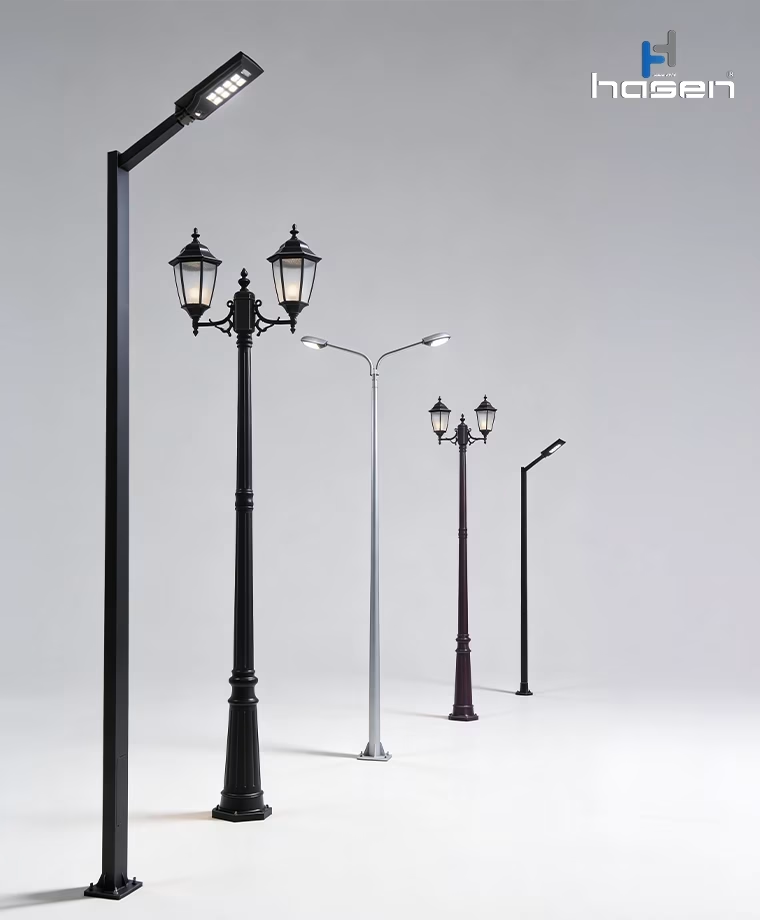
How an area looks at night is just as important as how it appears during the day. Especially for gardens, residential complexes, walkways, parks, and commercial properties, choosing the right lighting solution improves safety while also enhancing the aesthetic value of the environment. This is where outdoor lighting poles go beyond simply providing light and help create more comfortable, inviting, and functional spaces.
Today, outdoor lighting poles are manufactured in various heights, designs, and lighting configurations depending on the intended application. However, choosing the right product requires understanding the available models and the specific requirements they are designed to meet. So, what are outdoor lighting poles, and what types are available?
What Is an Outdoor Lighting Pole?
Outdoor lighting poles are exterior lighting systems used in gardens, residential complexes, parks, walkways, industrial facilities, building surroundings, and other open areas.
These poles are used not only to illuminate an environment but also to improve safety, increase nighttime visibility, and contribute to the visual character of the space.
Outdoor lighting poles can be categorized according to their application, height, material, and lighting technology, providing solutions for different project requirements.
LED-compatible lighting poles are widely used because of their low energy consumption, long service life, and flexible lighting performance. Short, medium, and tall pole models can also be used in environments ranging from small gardens to large social and commercial areas.
Decorative models are particularly suitable for residential entrances, landscape projects, commercial developments, public spaces, and areas where architectural or historical character needs to be preserved.
What Are the Different Types of Outdoor Lighting Poles?
Outdoor lighting poles are not standard products that can be applied in exactly the same way to every project.
As the size of the area, required lighting level, and aesthetic expectations change, the appropriate type of pole also changes.
LED Outdoor Lighting Poles
LED-compatible systems are preferred in many modern lighting projects.
One of their main advantages is the ability to control light distribution more precisely. The unnecessary upward light commonly associated with older lighting technologies can be reduced through modern LED optics.
This can be particularly beneficial in residential developments and landscaped areas, where reducing unnecessary light pollution while maintaining visibility is important.
However, not every LED luminaire is suitable for every pole.
For example, using a narrow-beam luminaire on a 7-meter pole may create strong differences between illuminated and dark areas on the ground. A wider optical distribution can provide a more uniform result depending on the project.
For this reason, the pole and luminaire should be evaluated as a complete lighting system rather than as two independent products.
Short and Medium-Height Outdoor Lighting Poles
Poles in the range of approximately 3 to 5 meters are frequently used in areas with significant pedestrian activity.
Because the light source remains closer to the user, these heights can help create a more controlled and comfortable lighting environment.
Typical applications include:
- Residential complexes
- Villa gardens
- Pedestrian walkways
- Landscape areas
- Small outdoor parking areas
One common mistake with shorter poles is using luminaires that are unnecessarily powerful.
Excessively intense light close to eye level can create glare, particularly along pedestrian paths. In many landscape lighting projects, poor user experience is caused not by product quality but by an inappropriate combination of pole height and luminaire output.
Pole spacing is another important factor with medium-height systems.
Increasing the spacing too much to reduce the number of poles may lower the initial investment cost, but it can also create dark areas between lighting points.
For pedestrian-focused projects, you can also review Hasen Flagpoles’ guide on how walkway lighting systems should be planned.
Double-Arm Decorative Outdoor Lighting Poles
Double-arm lighting poles are not used solely for decorative purposes.
They can provide a functional advantage in wide areas where light needs to be distributed in two different directions.
Typical applications include:
- Boulevard-style residential entrances
- Large landscaping projects
- Areas where pedestrian and vehicle routes run alongside each other
- Municipal and public landscaping projects
An important engineering consideration is that double-arm configurations can increase wind loading and the total load acting on the pole.
For this reason, foundation design, anchoring, pole dimensions, and structural calculations should be evaluated according to the complete system rather than applying the same specifications used for a single-arm pole.
This becomes particularly important in exposed locations and areas with strong wind conditions.
How Are Outdoor Lighting Pole Dimensions Determined?
One of the most common mistakes in lighting pole selection is reducing the decision to a single question: “How tall should the pole be?”
In reality, pole height is a technical parameter that should be evaluated together with the luminaire’s beam angle, lumen output, mounting spacing, and the geometry of the area being illuminated.
The same luminaire can produce very different illuminance and uniformity results when installed at different heights.
For example, relatively narrow optical distributions can direct light over a more concentrated area, while wider optics may provide more uniform coverage at lower or medium mounting heights.
The final selection should therefore be based on photometric performance rather than pole height alone.
The following factors are generally considered together:
- Width and geometry of the area
- Distance between lighting poles
- Luminaire beam angle
- Total lumen output
- Required illuminance level
- Pedestrian or vehicle traffic
- Safety requirements
- Purpose of the area
Choosing 3–5 Meter Outdoor Lighting Poles
Poles between approximately 3 and 5 meters are particularly suitable for areas where controlled, human-scale lighting is required.
Because they are closer to pedestrian level, they can contribute to a warmer and more balanced outdoor environment.
They are frequently used in:
- Internal residential roads
- Gardens and landscaping areas
- Walking paths
- Outdoor café areas
- Villa surroundings
An important consideration is that the performance of the same luminaire changes as mounting height increases.
A luminaire that provides sufficient illumination at 4 meters may not produce the same result when installed at 5 meters.
For this reason, pole height and lighting calculations should always be considered together.
When Should a 7 Meter Outdoor Lighting Pole Be Used?
7 meter outdoor lighting poles are commonly used in projects where wider areas need to be illuminated with fewer poles.
Typical applications include open parking areas, residential perimeter roads, factory sites, logistics facilities, and commercial properties.
The additional height allows the light to cover a wider area. However, as mounting height increases, the illuminance reaching the ground may decrease depending on the luminaire.
For this reason, higher-output LED luminaires and suitable optical systems are often required for taller poles.
Pole spacing should also be planned carefully.
One common mistake is increasing the distance between poles simply because taller poles are being used. Although this may reduce the initial number of poles required, excessive spacing can create poorly illuminated areas.
Seven-meter poles are generally more appropriate where area coverage is the main priority. They may be unnecessarily tall for small gardens or narrow pedestrian paths.
What Factors Affect Outdoor Lighting Pole Prices?
Outdoor lighting pole prices are affected by several factors, including material quality, dimensions, structural specifications, design, and surface treatments.
Contrary to common assumptions, pole height is not the only factor determining cost.
For example, a standard 5-meter galvanized pole and a decorative stainless steel pole of the same height can have very different manufacturing costs.
Similarly, increasing wall thickness increases the amount of material required and therefore affects the price.
For this reason, purchasing cost should not be evaluated independently from maintenance requirements, installation, corrosion resistance, and expected service life.
Main Factors Affecting Unit Price
The primary factors influencing the cost of outdoor lighting poles include:
- Pole height
- Pole diameter
- Wall thickness
- Material type
- Hot-dip galvanizing
- Electrostatic powder coating
- Decorative design details
- Single-arm or double-arm configuration
- Flange and anchoring system
- Wind-load requirements
- Luminaire load capacity
Material selection can also have a significant impact on lifecycle cost. For additional information, you can read Why Is Stainless Steel Preferred for Outdoor Poles?.
Should the Pole and Luminaire Be Evaluated Together or Separately?
The performance of an outdoor lighting system is determined by the combination of the pole and luminaire rather than either component individually.
Even a high-quality LED luminaire may not provide the expected performance when installed at an inappropriate height.
Likewise, a correctly designed lighting pole cannot compensate for a luminaire that does not provide the required optical distribution or light output.
For this reason, the two should always be evaluated together.
Professional lighting projects generally consider:
- Pole height
- Luminaire power
- Lumen output
- Optical beam angle
- Distance between poles
- Required lux level
For very large outdoor environments such as industrial facilities, logistics areas, parking areas, and large commercial sites, floodlight pole systems may also provide a more suitable solution depending on the lighting requirements.
Why Are Grounding and Installation Important for Outdoor Lighting Poles?
Incorrect installation and inadequate grounding can create serious problems in outdoor lighting systems.
A properly designed grounding system provides a safe path for fault currents and is particularly important in outdoor installations exposed to rain, moisture, and other challenging environmental conditions.
Important installation considerations include:
- Correct alignment of anchors
- Adequate structural strength of the concrete foundation
- Proper tightening of flange connections
- Correct connection of grounding conductors
- Watertight protection of cable entry points
Another common field problem occurs when the pole does not sit correctly on its foundation or flange system.
Over time, vibration can contribute to loosening at connection points if installation has not been carried out properly.
For this reason, professional installation is just as important as the quality of the pole itself.
How Should Standards and Installation Requirements for Outdoor Lighting Poles Be Evaluated?
Outdoor lighting is not solely an aesthetic or security application.
The products, electrical components, structural systems, and installation methods used in a project should comply with the technical standards and regulations applicable to the installation location.
Electrical infrastructure requirements become particularly important in public projects, residential developments, industrial facilities, and commercial areas.
The structural capacity of the pole, foundation design, wind loading, electrical safety, and environmental conditions should therefore be evaluated during the project planning stage.
For example, poles installed in locations exposed to strong winds may require different structural specifications than poles used in sheltered urban environments.
Project-specific engineering is therefore essential.
How Do You Choose the Right Outdoor Lighting Pole?
One of the simplest ways to begin selecting an appropriate outdoor lighting pole is to answer several basic questions:
- How large is the area?
- Is pedestrian or vehicle traffic more intensive?
- Is decorative appearance important?
- What climate conditions will the pole be exposed to?
- What illuminance level is required?
- How easy is maintenance access?
For projects expected to remain in operation for many years, focusing only on initial purchasing cost is not an effective approach.
Corrosion resistance, maintenance requirements, energy consumption, installation, and expected service life should all be evaluated together.
The correct product depends not only on the specifications of the pole itself but also on engineering decisions based on the characteristics of the installation area.
A well-planned outdoor lighting system can provide a safer and more comfortable environment while using energy more efficiently.
The 5 Most Common Mistakes in Outdoor Lighting Pole Projects
Many problems encountered in outdoor lighting projects are caused by incorrect planning or installation.
1. Using Poles That Are Taller Than the Area Requires
One common misconception is that a taller pole automatically provides better lighting.
In reality, every environment has an appropriate range of mounting heights.
For example, in villa gardens or pedestrian routes where human-scale lighting is important, poles of 7 meters or more may create an unnecessarily elevated light source.
Although light still reaches the ground, the environment may lose the balanced and comfortable appearance expected from landscape lighting.
Unnecessary light may also spread into areas where it is not required.
2. Leaving Excessive Distance Between Poles
Another common mistake is increasing pole spacing too much in order to reduce the number of lighting poles.
This can appear economical at first, but it often creates dark areas between illuminated zones.
For example, excessive spacing in a parking area may create shadows along pedestrian routes or vehicle circulation areas.
Uneven lighting can also reduce the effectiveness of security cameras.
The objective of a lighting project should therefore be to achieve appropriate and reasonably uniform illumination across the required area rather than simply illuminating individual points.
3. Evaluating the Luminaire and Pole Independently
Selecting the pole first and considering the luminaire later is another frequent mistake.
For example, installing a narrow-beam LED luminaire on a 7-meter pole can create strong transitions between bright and dark areas.
A different optical distribution may provide a much more balanced result on the same pole.
For this reason, pole height, luminaire power, lumen output, optical distribution, and pole spacing should be evaluated together.
4. Ignoring Corrosion Risk
Focusing only on how the pole looks when it is first installed while ignoring environmental conditions can create significant long-term costs.
Coastal locations are particularly demanding because poles may be exposed to salt, humidity, temperature fluctuations, and other corrosive conditions.
Products with inadequate surface protection may begin to show deterioration much earlier than expected.
Material selection and surface protection should therefore reflect the environmental conditions of the installation site.
5. Treating Grounding and Installation as Secondary Issues
Purchasing a high-quality pole is not enough if the installation is inadequate.
For example, installing a pole before the foundation has reached sufficient strength or incorrectly positioning the anchors can contribute to loosening, movement, or alignment problems over time.
Likewise, incomplete or incorrectly designed grounding can create serious electrical safety risks.
Professional installation, appropriate grounding, reliable foundation design, and correct anchoring are therefore fundamental parts of a successful outdoor lighting project.